The Quiet Between Guns
He saved her life. Now her law says he owns it.
A field medic saves an enemy officer her own command left to die. Vashen law says a life given back is a life owed, and the term is eleven years. He spends two of them trying to tear up his own paperwork.
Cosmic Chronicles · Sci-fi romance / Enemies to lovers / Wartime
Triage
The ceasefire was nine days old and holding the way a cracked cup holds water.
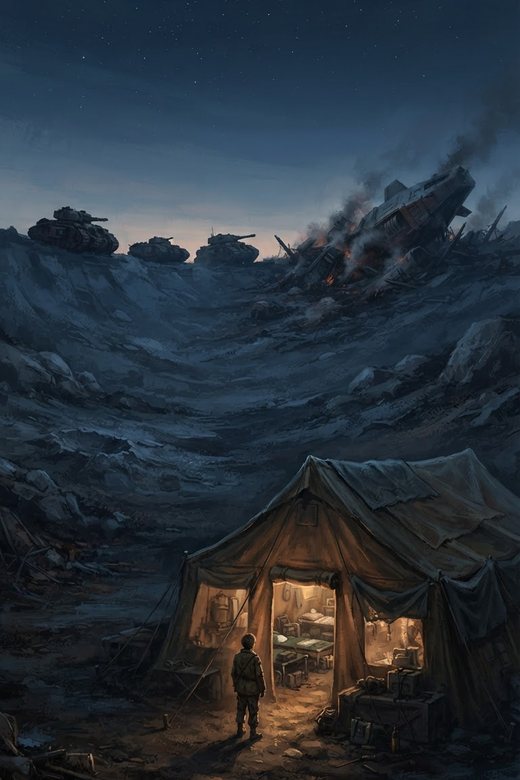
Kel Adisa had run the aid station at Grid Fourteen since the spring, which made him the longest-serving thing in it, including the tent. He had two nurses, a generator that worked when spoken to properly, and a standing order that said casualties were treated in order of severity without regard to uniform.
That order had been easy to admire in training. It was different at three in the morning with a Vashen line-officer bleeding out on his floor.
"Sir." Private Deyo had her hands full and her voice was doing the thing voices did in there, flat and fast. "Sir, this is a Vashen."
"I noticed."
"Command said..."
"Command said treat by severity. I've got a corporal with a broken wrist and I've got this." He was already cutting. The Vashen wore plate along the forearms and shoulders, natural growth rather than armour, and somebody had punched a fragment straight through the soft seam beneath it. "Guess which one's dying."
"They'll ask."
"They will," Kel agreed, "and I'll tell them, and it'll be a long night. Clamp."
She should not have survived the transport.
He learned later that she had been found in the buffer strip by a human forward patrol who could very easily have left her there and would have had a defensible reason. They carried her instead, four kilometres, in the dark, because the ceasefire was nine days old and nobody wanted to be the one who broke it.
That was the thing about the quiet between guns. It made people strange. It made them behave, briefly and unreliably, like the people they might have been.
Kel had her open for two hours. The fragment had gone through into the accessory lung, which the Vashen had and humans did not, and the surgical atlas in his tablet had four pages on Vashen anatomy and three of them were guesses. He worked from the two of them that weren't and from the shape of what he could see.
At some point Deyo said, quietly, "She's going to live."
"Don't say that in a tent."
"Sorry, sir."
She lived.
The Vashen woke on the second day and the first thing she did was try to work out how to kill him.
He could see it happening. She came up out of it fast, faster than a human would, vertical pupils narrowing to slits in the lamplight, and her eyes went around the tent in a precise sequence: exits, personnel, instruments, distances. Her plated forearm flexed once against the strap.
Kel did not move from the stool.
"Morning," he said. "You've got about forty minutes of that in you before you tear the graft and we do this again, and I'd rather not, because I used the last of the good sealant on you and the resupply is Thursday."
She stopped. Looked at him properly.
"You are the surgeon."
"I'm the medic. There's a difference and it mostly involves how much sleep I get."
"You are alone in a tent with a restrained enemy combatant and you have made a joke."
"It's been a long war." Kel leaned forward and checked the drain, which was behaving. "You want the medical version or the situation version first?"
Her jaw moved. The Vashen had a small set of plates along the line of it, and they shifted when she was working something out, which he would come to find was the most honest thing about her.
"Medical."
"Fragment through the accessory lung and out under the scapular plate. I've patched the lung and packed the tract and you'll keep both. You'll be short of breath for a season and you'll be no good above four thousand metres for a year. You will not run a line again."
He said the last part carefully, because he had worked out by then what her collar flashes meant.
The Vashen was quiet.
"Situation," she said.
"Nine-day ceasefire, holding. You were carried in by a human patrol who had no orders to do it. My command knows you're here because I told them, and they are currently deciding whether I am a problem." Kel spread his hands. "Your people have been informed through the buffer channel. They've acknowledged. They have not requested repatriation."
Her pupils widened, then contracted hard.
"Say that again."
"They acknowledged receipt. They did not ask for you back."
"That is not an oversight."
"No," Kel said. "I didn't think it was."
She told him on the fourth day, because by then she had worked out that he was going to keep coming in and sitting on the stool whether she spoke or not.
Her name was Sar Anneth. She had held a line at the Bhal cut for six weeks against an assessment that said it would fall in nine days, and she had done it by disobeying a withdrawal order twice, and both times she had been right, and the second time had cost the Vashen command a great deal of face in front of their own general staff.
"So they left you," Kel said.
"They left an officer who cannot run a line." Her voice was flat. "That is not the same and I would prefer you did not soften it. I am no longer useful and I have been an embarrassment, and there is a mechanism for that which does not require anybody to give an order they would have to sign."
"And the mechanism is that you're just... not requested."
"The mechanism is that I am saved," said Sar Anneth.
Kel waited.
She turned her head on the pillow and looked at him with those vertical pupils and he understood that whatever came next was going to be the actual conversation.
"Vashen law," she said. "A life given back is a life owed. It is not a sentiment, medic, it is a statute, and it has a schedule and a registry and offices with clerks in them. When you opened me on that table you did not perform a kindness. You created an instrument."
"I don't want an instrument."
"That is not relevant. It is not a contract, it does not require agreement, it does not have a party who may decline." Her jaw plates shifted. "You saved my life. Therefore my life is yours. Therefore I am, in the eyes of every court my people keep, your property until it is discharged."
The generator ticked over outside.
"No," said Kel Adisa.
"You do not have the standing to refuse."
"I'm refusing anyway."
"Then hear what refusing does." Sar Anneth's voice did not rise, and somehow that was worse. "An undischarged debt held by an enemy is a security condition. If you refuse the instrument, the debt does not vanish, it becomes unresolvable, and an unresolvable debt on a Vashen officer is closed by the only remaining method." She held his eyes. "They will send someone. It will be quiet and it will be within the month and it will be recorded as a complication of surgery, which, medic, is a thing your paperwork will support."
Kel sat very still on his stool in his own tent.
"That's why they didn't request you."
"That is why they acknowledged and did nothing. They are waiting to see whether you keep me or refuse me. Either way the problem resolves." She let out a breath and he heard the damaged lung in it. "You have been handed an officer with a reputation, a wound, and no line to run. One of us walks out of this and it is not both."
"There's a third option."
"There is not."
"There's always a third option, it's just usually stupid." Kel scrubbed a hand over his face. He had been awake for twenty hours and he had a corporal with a broken wrist and a generator with opinions and now this. "Alright. Talk me through the discharge. You said there's a schedule."
Sar Anneth's plates went still.
"You are asking how to own me properly."
"I'm asking how the debt ends. Those are different questions and you know they're different or you wouldn't have flinched."
"I did not flinch."
"Your jaw did."
There was a long pause, and then Sar Anneth of the Bhal cut, who had held a line for six weeks against an assessment, made a sound that Kel could not read at all.
"Service," she said at last. "The debt discharges through service, rendered to the holder, in the holder's interest, over a term set by the value of the life. Mine is an officer's life. The term is not short."
"How not short?"
"Eleven years."
Kel Adisa sat in the quiet between guns and did the arithmetic on a war that had already taken six of his and looked, from the inside, like it had a great many left in it.
"Right," he said. "Then we'd better find something for you to do."
The Term
Command sent a major.
He arrived on the eleventh day with a driver and a folder and the particular calm of a man who has been given an unpleasant job and intends to do it in one visit. His name was Okonkwo and he had been a decent officer once, and possibly still was, and Kel disliked him on sight for reasons that were entirely about the folder.
"Sergeant Adisa. You are aware you're holding an enemy line-officer."
"I'm aware I treated one."
"You are aware she has been declared surplus by her own command and that this makes her, for our purposes, a defector, an asset, or a corpse, and that the determination is above your pay grade."
"I'm aware it should be."
Okonkwo looked at him for a moment and then, unexpectedly, sat down on the ammunition crate that served the aid station as a chair.
"Talk to me plainly, sergeant, and I'll do you the same courtesy. What do you actually want here?"
Kel had been rehearsing versions of this for a week and every one of them had been too clever. He abandoned all of it.
"I want her to not be killed by either side for the crime of having survived my surgery," he said. "That's the whole of it. I don't want an asset. I've got no use for a defector. I want the woman to be alive in a year and I have run out of ways to arrange that which don't involve doing something I find repellent."
"Which is?"
"Vashen law says she's mine. Actual property, actual registry, eleven-year term." Kel's jaw tightened. "If I refuse it, they send someone. If I accept it, they don't, because the instrument is valid and the Vashen do not interfere with a valid instrument, it's the one thing their whole legal system is built to protect."
Okonkwo was quiet for a long moment.
"You're asking me to let you claim ownership of a person."
"I'm asking you to let me register it. There's a difference and I intend to spend eleven years living inside it."
"There is no difference on paper."
"No," Kel agreed. "There isn't. That's what makes it repellent."
The major looked at the folder in his hands. Then he looked at the tent flap, beyond which a Vashen officer was doing supervised walking laps of a mud track because the medic had told her that lungs recover through use.
"Does she know you're going to do this?"
"She proposed it. On day four. I told her no." Kel let out a breath. "I've been trying to find a better answer for a week and there isn't one. Every road out of this ends with her dead except the one that ends with her owned."
Okonkwo stood.
"I'll sign a receipt of custody," he said. "Not an ownership. Ours won't recognise theirs and I'm not putting my name to a chattel instrument for a court in Bhal, and frankly nor should you." He tucked the folder under his arm. "But I will file that she is in your custody under the ceasefire protocol, with the Vashen registry number appended as a notation of foreign status. Their clerks will read it as a valid instrument because it has the number on it. Ours will read it as a prisoner assignment. Both will be satisfied and neither will be lied to."
Kel stared at him.
"That's..."
"That is nine years of staff work, sergeant, and you may have it for free." For a moment something tired and human came through. "I have signed a great many things this war. This is the first one in some time that I expect to feel alright about."
She took it badly, which he had not anticipated.
"You have made a fiction."
"I've made a notation."
"You have made a document that says two things to two readers and you are pleased with it." Sar Anneth was standing, which she was not supposed to be doing for more than ten minutes at a stretch, and her plates were up along the forearm. "Medic. Listen to me. The instrument is not paperwork. It is not a formality that can be satisfied by a clever number in a margin. It is the actual condition of my life, and you have papered over it, and when it is tested it will not hold."
"Then we'll deal with it when it's tested."
"You do not understand what testing means."
"So explain it."
"It means a Vashen officer of the registry arrives and requires me to demonstrate service." Her breathing had gone short and she made herself slow it. "Service, medic. Rendered to you, in your interest, at your direction. Observed. And if I cannot demonstrate it, the instrument is void, and if the instrument is void then we are back at the beginning except that now you have been seen to try."
Kel sat down on the stool.
"Then demonstrate it."
"What?"
"You heard me. You want service in my interest, at my direction, observable by anyone who cares to look." He gestured at the tent. Two nurses. A generator with opinions. Forty beds and a resupply that came Thursday and was never enough. "I am one medic running a station built for four. I have a corporal whose wrist I set badly because I was tired. I have a sterilisation cycle that I skip about twice a week and lie about in the log."
Sar Anneth went very still.
"You are asking me to work."
"I'm asking you to work. In my interest. At my direction. In front of anybody who wants to watch." Kel spread his hands. "Your registry wants service. Fine. There's a war on and I am drowning. That's not a fiction. That's the most honest thing in this tent."
She was, it turned out, extremely good at it.
Not the medicine. She had no training and never pretended to. But Sar Anneth had run a line at the Bhal cut for six weeks on a supply chain that had been written off, and it turned out that everything that made her impossible to dislodge from a ridge made her equally impossible to dislodge from a quartermaster.
The resupply came Thursday and was never enough. Within a month it came Tuesday and Friday and was enough.
"How," said Deyo, holding a crate of sealant.
"She wrote to them."
"She wrote to our logistics."
"Twice a day for three weeks. In writing, with a reference number, cc'd to a major." Kel took the crate. "She says a supply chain is a line and a line is held by making it more expensive to fail than to function. I've decided not to ask any further questions."
The autumn came in wet.
The ceasefire held, which nobody had expected, and then it held some more, and slowly the aid station at Grid Fourteen turned into something that was not quite a field hospital and not quite a village. Vashen wounded came in over the buffer strip. Human wounded came down from the ridge. Somewhere in there the standing order about severity stopped needing to be quoted at anybody.
Kel worked. She worked. They were both extremely tired for a very long time, and in the way of such things they became, without either of them marking the day, necessary to each other.
He noticed it on a night in the ninth month, when the generator finally died in a way that could not be spoken to and he came out of the tent at two in the morning to find her already there with the housing off and a lamp in her teeth.
"You should be asleep."
"So should you. Hold this."
He held it. She worked. Her plates caught the lamplight, and her breathing was still short and always would be, and she swore in Vashen at a bolt that had rusted into its seat.
"Sar."
"Mm."
"How long has it been?"
"Nine months and four days." She did not look up. "Of eleven years. I keep the count. It is expected."
"Do you want to keep the count?"
The wrench stopped moving.
Sar Anneth took the lamp out of her teeth and set it down on the housing, and turned, and looked at him in the dark outside a tent in the ninth month of a ceasefire nobody had believed in.
"That," she said, "is the first question you have asked me that the statute does not have an answer for."
"I know."
"You should not ask it. There is no version of me answering it that is not a person owned answering her owner."
"I know that too." Kel's throat was tight. "That's exactly why I've not asked it for nine months and four days."
The rain came across the compound in a long slow sheet.
"Ask me again," said Sar Anneth, "when it is not true."
"That's ten years and a bit."
"Yes."
"That's a very long time to wait for an answer."
"It is," she agreed, and picked the lamp back up, and put it in her teeth, and went back to the bolt.
Kel Adisa stood in the rain holding a generator housing for a woman he legally owned and understood, with total clarity, that he was going to spend the next ten years finding a way to tear up a piece of paper.
Discharge
The officer of the registry came in the second spring.
Kel had stopped expecting him by then, which was exactly the mistake Sar had warned him about eighteen months earlier and had been too polite to mention since. He arrived on a grey morning with two clerks and a case, and he was small for a Vashen and entirely bald of plate along the jaw, which Sar told him afterwards meant civil service to the bone.
"Registrar Ohv," he said. "I am here to test an instrument."
They did it in the tent, because Kel refused to do it anywhere else, and it took four hours.
Ohv had the paperwork. He had the notation of foreign status and the registry number and Major Okonkwo's receipt of custody, and he read all of it twice with an expression of mild professional interest, and then he set it down.
"This document is a fiction."
"It's a notation."
"Sergeant, I have been a registrar for thirty-one years. I have read four thousand instruments. This one says two things to two readers and somebody was pleased with it." Ohv folded his hands. "Fortunately for you, that is not the test. The test is service. Demonstrate it."
So they demonstrated it.
It took the four hours because Sar Anneth, who kept the count, also kept the log, and the log was eighteen months of quartermaster correspondence, requisition chains, sterilisation cycles, resupply schedules, bed rotations and a generator maintenance record so thorough that Ohv stopped at one point and asked, with what might have been feeling, whether she had considered the civil service.
At the end of it the registrar sat back.
"The service is rendered," he said. "It is rendered to the holder, in the holder's interest, at the holder's direction, and it is observable, and I would call it substantial. The instrument holds."
Kel let out a breath he had been holding for eighteen months.
"However," said Ohv.
"There is a schedule," the registrar said. "You know this. An officer's life carries an eleven-year term. Service accrues against the term at a rate set by category, and the categories exist because a life given back is not repaid by any amount of ordinary labour, and the statute is not sentimental about that."
"How much has she accrued?"
Ohv consulted the case.
"At domestic category, which is the default for a holder with no military standing to assign, eighteen months of service discharges eighteen months of term." He looked up. "Nine and a half years remain."
"And if the category isn't domestic?"
"Then it is not domestic, sergeant, and we would be having a different conversation. But your major's receipt assigns her to your custody as a private person, and you are a private person, so the category is domestic, and nine and a half years remain."
Sar Anneth had not spoken in some time.
"Registrar," she said. "The Bhal cut."
Ohv turned his head.
"Six weeks," she said. "Against an assessment of nine days. Two withdrawal orders disobeyed. Eleven hundred Vashen off that ridge alive who were written off before the first shot."
"I am aware of the Bhal cut, officer. Everyone is aware of the Bhal cut. It is the reason your command left you on a table in an enemy tent rather than sign anything with their name on it."
"Then you are aware there is a category for it."
The tent went very quiet.
Kel looked between them. "What category?"
"She is asking," Ohv said slowly, "whether the eleven hundred lives she preserved at the cut may be set against the one life she owes."
"Can they?"
"It has been done." The registrar's fingers had gone still on the case. "Twice. Both times a century ago. It requires a finding that the officer's prior act preserved life in the holder's interest, which is the difficulty, because the holder is human and the cut was a Vashen action against humans."
"No it wasn't," said Kel.
Ohv looked at him.
"It wasn't," Kel said again. He was standing now and he did not remember deciding to. "I've read the after-action. Everybody's read the after-action, it's the most famous engagement of the war. The Vashen command wanted the cut abandoned so they could pull the line back to the Ossa shelf, and the Ossa shelf is fifteen kilometres from Grid Fourteen, and if they had done it, this aid station and every human position east of the river would have been inside the new envelope by the winter."
He put a hand flat on the table.
"She held a ridge she was ordered to give up. Every human being in this valley is alive because she did. I have been treating them for two years." His voice was not steady and he did not care. "Registrar, you want a finding that her prior act preserved life in the holder's interest. I am the holder. I have four hundred and sixty case files in that crate and I will read you every single name."
Registrar Ohv of the Vashen civil registry sat in a human field hospital and was silent for a long time.
"Officer Anneth," he said at last. "Did you know this?"
"I held a ridge," said Sar. "I did not hold it for them. I held it because giving it up was wrong and I have never in my life been able to do the wrong thing efficiently."
"That is not an answer."
"It is the only one I have."
Ohv looked at Kel. Then at the crate of case files. Then, for a long moment, at nothing at all.
"I will need the names," he said.
It took nine days.
Sar read them aloud because Ohv required it read by a party to the instrument, and Kel could not have done it without stopping, and they both knew it. Four hundred and sixty case files. Every one a person who had come down off a ridge or in from a valley that would have been behind a Vashen line by the winter.
She read them in a flat administrative voice and her plates did not move once, and on the sixth day Kel went outside and stood in the compound for twenty minutes and then came back in.
On the ninth day Registrar Ohv closed his case.
"The finding is made," he said. "Prior preservation of life in the holder's interest, four hundred and sixty instances, set against a term of eleven years." He was writing as he spoke. "The term is discharged. The instrument is void. Officer Anneth carries no debt to any party and has full standing before any Vashen court."
He tore a page from the pad, stamped it, and set it on the table.
Nobody picked it up.
"I will also file," Ohv added, in the same dry voice, "that the officer's conduct at the Bhal cut is hereby a matter of registry record rather than command rumour, which I expect will cause a considerable amount of trouble for a considerable number of people, and I find that I am at peace with it."
He stood, and gathered his clerks, and paused at the tent flap.
"Sergeant. A word of professional caution."
"Registrar."
"The instrument is void. The condition it created is not." Ohv's flat black eyes went, briefly, to Sar Anneth. "For two years she has had no standing from which to answer any question you might have asked her. That is now changed and it changed ten minutes ago, and in my experience people in your position mistake the paperwork for the moment." He inclined his head. "It is not the moment. Do not use it as one."
He left.
They did not talk about it for three days, which Kel thought was probably the registrar's fault and definitely the right call.
On the fourth evening he found her on the ridge track above the compound, where the ground came up enough to see the whole valley: the tent lines, the generator shed, the mud road that came down from the cut and was, that spring, entirely quiet.
"Nine and a half years," Kel said.
"Nine and a half years."
"You had the answer the whole time."
"I had a theory the whole time. There is a difference and it is roughly the width of a registrar." Sar Anneth's breathing was short in the cold, and always would be. "I did not raise it because raising it would have been asking you to argue for me, and I could not ask you for anything. Not once. Not in two years."
"You could have."
"No," she said. "I could not, and that is exactly the thing you have never been able to make yourself understand, and I have loved you for it and it has been extremely inconvenient."
Kel's breath stopped somewhere around his sternum.
Sar turned. In the last of the light her plates showed the fine seam under the shoulder where he had opened her, two years and one month ago, on a table, at three in the morning.
"You asked me a question in the rain," she said. "In the ninth month. You asked whether I wanted to keep the count. I told you to ask me again when it was no longer true."
"I remember."
"It is no longer true."
The valley lay under them, and the road was quiet, and nine kilometres east a ridge that a woman had refused to give up stood in the dark exactly where it had always been.
"Sar Anneth," said Kel Adisa. "Do you want to stay?"
And Sar Anneth, who had held a line for six weeks against an assessment, who had been written off and left on a table and owned for two years by a man who had spent every one of those days trying to find a way to tear up a piece of paper, said:
"Ask me for something."
"What?"
"Anything. A small thing. It does not matter what." Her voice had gone rough. "In two years you have never once asked me for anything, because you could not bear to, and I have understood exactly why and I have not been able to stand it. Ask me for something now, when I can refuse, so that we both find out what it is worth."
Kel thought about it for a while.
"Stay," he said. "Not for eleven years. Not for nine and a half. Just tomorrow, and then we'll see."
"That is a very small thing."
"It's the biggest one I've got."
Sar Anneth put her plated hand over his, out on the ridge track above Grid Fourteen, in the quiet between guns.
"Yes," she said.
That is the end of the book. There are more full-length stories, early access and the complete catalogue on Patreon.
Read more on Patreon Back to the library