The Cartographer's Debt
He woke her. By her law, that makes her his.
A surveyor wakes the last survivor of a derelict generation ship. Her people's law binds her to whoever wakes her. He refuses, and finds out that a refused debt has no end.
Cosmic Chronicles · Sci-fi romance / First contact / Slow burn
The Amber Pod
The Hesper Vane had been dead for four hundred years, and nobody had bothered to tell it.
Idris Vale had boarded a lot of dead ships. Most of them announced it. They went quiet in a way that felt structural, like a house with the roof off: pressure gone, systems cold, the particular stillness of a thing that had stopped pretending. You learned to read it through the boots.
The Vane wasn't doing that. The Vane was humming.
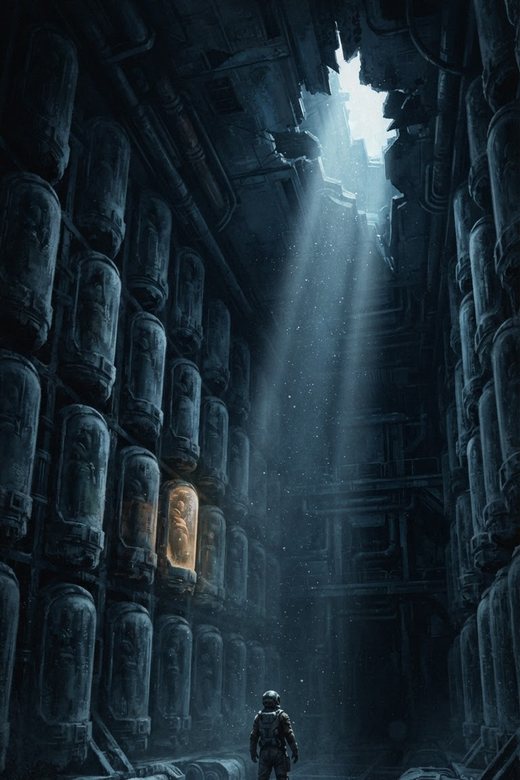
He stood on the gantry above the cryo bay with one glove on the rail and listened to it through his suit. A low three-note cycle somewhere far below, a pump doing its work exactly as designed, patient as a heartbeat. Four centuries adrift between two stars that didn't care, and something down there was still moving fluid around.
"You're a stubborn old thing," he said. His breath fogged the visor and cleared.
The bay went down forty metres and back another two hundred, ranked with pods in stacks eight high. He'd surveyed generation ships before. He knew the arithmetic of them, how many people it took to make the crossing and how many the crossing took back. He put the count at eleven thousand and did not enjoy doing it.
Every pod was dark.
He walked the gantry anyway, because that was the job and because the job was a good place to put his hands when the rest of him wanted to be elsewhere. Survey, catalogue, log, leave. The Cartographers' Guild paid by the derelict and paid better for a clean chart, and a clean chart meant walking the whole thing rather than guessing at it. He swept the lamp left and right. Frost. Dust in the beam, hanging where the air had stopped bothering to move. Row after row of small dead windows.
He was ninety metres in when the lamp caught something warm.
Idris stopped. Backed up two paces. Swung the beam wide and then narrow, and there it was, four rows up and eight along: one pod glowing a soft amber from the inside, like a lit window in a street where every other house had been abandoned.
"No," he said, to nobody, with feeling.
He climbed anyway.
The readout on the pod was in a script he didn't know, but numbers are numbers if you look at them long enough, and machines that keep people alive tend to say similar things in similar places. Temperature. Pressure. A slow green pulse that had to be a heart.
He wiped the frost from the viewport with the heel of his glove.
She was not human. That much resolved immediately and without drama, because the proportions were wrong in a way that had nothing to do with damage. Too long through the forearm. A ridge of something fine and dark running back from the temple where hair would be, laid flat like a bird's crest folded down. Skin the grey of wet slate. Her hands were crossed on her chest in a way that looked less like repose and more like someone had arranged them.
Idris had been alone for seven weeks. He was aware that this made him a bad judge of his own reactions, and he stood there a while longer to give the feeling time to become something he could name.
What it became was this: someone put her here on purpose, and then everyone else died.
He checked the pod's power chain. It ran back into the wall, down, and away toward the humming. There, spliced crudely into the main, was a second cable. Newer. Hand-run. Someone had cannibalised the bay to keep exactly one pod alive, and done it in a hurry, and hadn't come back to tidy it.
He thought about the eleven thousand dark windows behind him and felt the cold come through the suit in a way the suit shouldn't have allowed.
Protocol was clear. Do not revive. Log position, flag for a recovery vessel, withdraw. The Guild had written that rule after a surveyor on the Kalliope thawed out a passenger who turned out to have been in cryo for a reason, and the resulting inquiry ran to nine hundred pages.
Idris read the rule again in his head, the way you press a bruise.
The nearest recovery vessel was eight months out. The pod's power was being fed by a splice a dying man had made with his hands. He looked at the amber light and did the only arithmetic that mattered, which was that eight months and a cable somebody rigged in a panic were not two numbers that belonged in the same sentence.
"Right," he said.
Waking took two hours and he spent most of it talking, because the alternative was listening to the pump.
He told her about the ship, that she was drifting, that her heading had decayed, that whatever the Vane had been aiming for it was now going to miss by a margin that didn't bear thinking about. He told her the pods were dark. He told her his name and his ship's name, and that his ship was small and ugly and called the Bellwether, and that he'd had it fourteen years and it had never once let him down in a way he couldn't fix with a hammer.
He was aware she couldn't hear him. He kept going.
When the seal broke, the smell that came out was not the sour chemical stink he expected. It was faintly green, like the inside of a greenhouse. It undid him a little.
Her eyes opened. A second lid went sideways across them, cleared, went back.
She looked at the ceiling for a long moment. Then at the dark pods. Then, slowly, at him.
Idris raised both hands, palms out, the universal for I am not doing anything. "You're safe. Your ship's dead but you're not, and I have air and heat two hundred metres that way. Take your time."
She said something. The suit's translator chewed on it and offered him nothing.
"I don't have your language yet. Give it a minute, it learns."
She said it again, slower, and this time with her hand moving in a small deliberate arc, palm turning up.
The translator caught the edge of it. "...who wakes."
"Idris," he said, and touched his chest. "Idris Vale."
Something happened in her face that he would think about for a long time afterwards. A settling. Like a woman hearing a diagnosis she'd already guessed.
She got out of the pod. She was unsteady and she was tall, taller than him by a head, and she got her feet under her and would not take the hand he offered. She stood on the gantry in a dead ship in front of a stranger, four hundred years from everyone she had ever known, and she did not shake.
Then she knelt.
"Whoa. No. Hey." Idris went down with her, which was the wrong instinct but was the one he had. "Get up. The floor's cold. Get up."
The translator was catching up now, stitching sense out of the second and third sentences even as it lost the first.
"...by the hold and the holding, I am woken and I am owed. My breath is your breath. My hands are your hands. Name me and I will answer to it. Sennah of the Ninth Hold is what I was called before. It is yours now to keep or to change."
Idris knelt on the freezing gantry of the Hesper Vane and understood, with total clarity and no useful ideas whatsoever, that he had made a mistake whose shape he could not yet see.
"Sennah," he said, because it was the only part of it he could hold. "That's a good name. Keep it. It's yours. I'm not..."
He stopped. Started again.
"I'm not owed anything."
Her second lid went across. Came back.
"Say it again," the translator said.
"I'm not owed anything. There's no debt. I found a pod with a light on and I opened it. Anyone would have."
The silence that followed had a quality he didn't like at all. Not shock, and not relief either.
Something closer to grief.
"You do not know what you have said."
"Then tell me."
Sennah rose. She did it slowly, the way you stand when standing costs you, and she looked down at him from her considerable height with an expression he had no framework for.
"A woken debt can be discharged," she said. "Served, or bought out, or carried until it thins. It has an end. Every one of us is taught the shape of it before we are taught to read."
She looked, once, at the eleven thousand dark windows.
"A refused debt has no end. There is no rite for it. There is no word for what I am now, in my language, and there was no need for one, because in eleven thousand years no one has ever been fool enough to do what you have just done."
Idris got up off the floor.
"Okay," he said carefully. "So we find the word."
And Sennah of the Ninth Hold, last of her ship and first of her kind to be refused, made a sound he would not learn the meaning of for another six days.
Nine Days
The Bellwether had four rooms and Sennah did not fit in any of them.
She managed the galley by sitting on the floor. She managed the cockpit by not going in. The corridor she took at a permanent slight stoop, one hand trailing the ceiling pipe, and after two days Idris caught himself walking the same way out of some idiot solidarity and made himself stop.
On the third day he found her in the hold with a wrench, tightening a bracket he'd been meaning to get to for a year.
"You don't have to do that."
"I know."
"That's sort of my point."
Sennah set the wrench down on the deck, squarely, the way she did everything. She had a habit of placing objects rather than putting them, as though each one had a correct location and she was returning it. "You have said what I owe. I have heard you. It does not stop the bracket from being loose."
He had no answer for that, so he got the second wrench and they did the rest of the run together, and it was the first hour since the cryo bay that felt like anything other than an emergency.
The translator improved. By the fourth day it had stopped hedging and started arguing with itself, offering him two readings of a word and letting him pick.
He learned that the Hesper Vane had launched with eleven thousand two hundred and six people aboard and a target four hundred and sixty years out. He learned that the Ninth Hold had been the agricultural deck, and that Sennah had been what the translator kept wanting to call a quartermaster before settling, eventually, on the one who decides who eats.
He learned that this was not a small job on a ship with a four-century crossing ahead of it.
"So what happened?"
They were in the galley. She was on the floor with her back to the cupboards and her knees up somewhere near her chin, and she had discovered that he had coffee and that she loathed it, and she kept drinking it anyway with an expression of grim scientific interest.
"A cascade in the sixty-first year," she said. "The primary went out. Then the secondary, because the secondary was never truly a secondary, it was the primary with a different label, which everyone knew and no one wrote down."
"Ah."
"You have met this ship."
"I've met a hundred of this ship."
Sennah made a sound that the translator declined to render and that he was fairly sure was a laugh. It was the first one.
"There was power for the pods or power for the bay. Not both. Eleven thousand pods draw what they draw."
She said it the way she said everything about that ship, which was the way a woman reads out a stock level. Flat. Countable. A number that does not care whether you like it.
Idris waited.
"They ran a lottery," she said. "It was fair. I want you to understand that it was genuinely fair, because when I say the word you will hear something ugly in it, and it was not ugly. It was the last decent thing that ship did."
"And you won."
"No." She turned the mug in her hands. "My father won. He was ninety-one and he had a bad hip and he could not run the agricultural deck if the ship ever woke, and I could. So he spliced a cable."
The pump. The hand-run line. The hurry.
"He did not tell me. He would have known I would refuse, and he would have known I could physically prevent him, because I could have. So he waited until I slept and he did it, and by the time the bay staff found the splice the power was already committed and undoing it would have killed me without saving anyone."
She drank the terrible coffee.
"There were four hundred people still awake to see it done. Not one of them reported him. That is the part I think about."
Idris sat down on the galley floor. It was cold and it put his head roughly level with hers, and he did it because standing over her while she said that would have been obscene.
"I'm sorry."
"You are the reason I am here to be sorry to."
"That's not the same as it being alright."
Sennah looked at him for a while.
"No," she agreed. "It is not."
He asked about the sound on the sixth day, which he thought was restrained of him.
"It has a name but the name is only used for that sound, so telling you the name will not help."
"Try me."
"Kaiven." She said it flat. "It is what you make when a rite fails. Not when it goes badly. When it fails, when the thing it was supposed to do simply does not happen, and everyone present understands that they are now in a situation with no shape."
"And there's a specific noise for that."
"There is a noise for everything. Four hundred years on a ship. Plenty of time, nothing to spend it on."
He laughed before he could stop himself, and she watched him do it with what he was learning to read as interest.
"You do that easily," she said.
"Laugh?"
"Yes."
"Is that strange?"
"It is very strange." She set the mug down, placed it. "Your people are supposed to be dangerous. It is in every account we have of you. Fast, and difficult to kill, and disproportionate. There is a word your species has that we borrowed whole because we had nothing like it. Spite."
"That's not flattering."
"It was not meant as flattery. It was meant as a warning, and the warnings are correct, and I have read enough of them to know what you are." She looked at him steadily. "And you knelt on a cold floor so that I would not have to look up at you."
"I fed four hundred people for six weeks on what was meant to last nine days," she said. "You learn to read a person by what they do with a short ration. Most take. A few share and want it seen. Twice in my life I have watched someone give theirs away and then leave the room so that nobody could thank them for it."
Idris found that he had nothing at all to say.
"That is the part the accounts leave out," Sennah said. "I would like to know why."
On the eighth day they found the mission file.
He'd been picking through the Vane's archive in the evenings, mostly out of professional habit, and the Guild would want a chart of the ship's intended course whether or not anyone ever flew it. The file was corrupt in the middle and stubborn at both ends and it took him four sessions to get a heading out of it.
When he did, he sat looking at the screen for a long moment before he called her in.
"Sennah. Your target. Halvan's Reach."
"Yes."
"It was settled."
The silence behind him went absolute.
He turned the display so she could see it. "Not by you. By a slower ship out of the same system, eighty years behind you, that took a shorter line because by then somebody had worked out a shorter line. They made planetfall two hundred and twelve years ago. There's a colony, Sennah. There are nine hundred thousand people down there and about a third of them have names that look like yours."
Sennah did not move.
"Say the rest of it."
"There's no rest of it. That's the whole thing. Your people made it."
"There is a rest of it," she said, "or you would not have gone quiet before you said the first part."
He should have expected that. She had spent eight days learning him with the same terrible thoroughness she brought to everything else.
"The Vane's manifest is on file down there," he said. "As lost. Eleven thousand two hundred and six names, and every one of them has a stone. They built a whole hall for it." He made himself say the next part cleanly. "You have a stone, Sennah. With your name on it. Your people held a funeral for you a hundred and ninety years ago and it was very well attended."
Sennah of the Ninth Hold sat down on the deck of the Bellwether, in the corridor, under the pipe, with her long legs folded and her back against a wall she'd tightened a bracket on.
"Then I cannot go," she said.
"What? Of course you can go. It's four months. I'll take you, that's not even a question, I'd take you if it were a year."
"You are not listening." Her voice had gone very quiet and the translator dropped its volume to match, which he had not known it could do. "A woman who is dead has no debt. It ended when the stone went up. Whatever I am now, whatever kaiven made of me, it does not follow me past that hall. I would walk in there as a dead woman come back and I would walk out as a citizen of Halvan's Reach with no obligation to anyone living."
She looked up at him.
"Do you understand what I am telling you?"
He did. He understood it completely and immediately, and it went through him like cold water.
She was telling him there was a way out. A clean one, sanctioned by her own law, four months' flight away, and it cost her nothing except that she would never see him again and would owe him nothing when she stopped.
She was telling him she had found the word.
And she was still sitting on his floor at two in the morning explaining it to him instead of asking him to set the heading.
"Sennah," Idris said.
"Yes."
"Do you want to go?"
The pump hummed somewhere behind the wall, four hundred years old, still moving fluid around, still doing the one thing it had been built to do.
"No," said Sennah.
The Hall of Stones
They went anyway.
It took four months and six days, and Idris spent most of it discovering that a ship built for one is not built for one plus a very tall woman who cannot sit down anywhere comfortably. He cut the bunk frame out of the second cabin and welded it back in a hand longer. He moved the galley shelf up. He gave up on the corridor entirely and learned to duck under her instead, which she found funnier every single time and which he therefore kept doing.
Somewhere in the second month they stopped being two people managing a situation.
He could not have said which day. There was no day. There was a long slow accumulation of small things that were not for anybody's benefit but their own: the way she started leaving the galley light on for him when he ran the late nav shift, the way he stopped announcing himself before coming into the hold. She learned to swear in his language and did it with a precision that made it much funnier than it should have been. He learned nine words of hers and mispronounced all of them and she never once corrected him, which he eventually worked out was itself a kind of affection.
On the ninety-fourth day she asked him about the Kalliope inquiry, the nine hundred pages, and he told her the whole ugly thing, and at the end of it she said, "So the rule exists because a man did the right thing and it went wrong."
"The rule exists because a man did the reckless thing."
"You opened my pod."
"I did."
"Against the rule."
"Yes."
"Why?"
He had been waiting four months for her to ask him that directly and had never once managed to build an answer that survived contact with the question.
"Because the light was on," he said.
Sennah considered this.
"That is not a reason."
"No."
"It is a very poor reason. It would not survive an inquiry."
"It absolutely would not."
"Good," she said, and went back to her wrench, and Idris stood in his own hold for a while with a feeling in his chest that he had no rite for either.
Halvan's Reach came up green.
He had charted forty-one settled worlds and none of them had ever done that to him. He was a man who read planets as survey problems: mass, atmosphere, a column of numbers that resolved into habitable or not. He was not prepared for the way it looked out the forward port with the terminator crawling across it and a whole continent of farmland catching the light.
Sennah stood behind his chair with one hand on the headrest and did not say anything for six minutes.
Then she said, "They grew it."
"They did."
"That is not a natural biosphere. That colour is a Ninth Hold strain. My grandmother's people bred that colour into a grass that was supposed to die on any world with more than one moon."
Her hand tightened on the headrest.
"They carried the seed. Eighty years behind us and they carried the seed and it took."
The Hall of Stones was on the northern edge of the first landing site, and it was enormous, and it was quiet in the way that only a building built for grief is quiet.
Eleven thousand two hundred and six names. Cut into black basalt in six rows of columns that went up further than the light reached, and at the base of each column somebody had left something. Grain. Small carved things. A child's shoe, which Idris looked at once and then did not look at again.
They walked it for an hour before they found her.
SENNAH, it said. NINTH HOLD. THE ONE WHO DECIDED WHO ATE.
And under it, smaller, cut later by a different hand:
SHE FED US ON THE WAY.
Sennah stood in front of her own gravestone in a hall full of the names of everyone she had ever known, and Idris Vale stood one respectful pace behind her and understood that whatever happened in the next few minutes, he had already done the thing he came to do.
"Someone added that."
"Looks like it."
"That is not a funerary form. That is a thank you. You do not put a thank you on a stone." Her voice had gone strange. "Somebody stood here with a chisel and broke the form on purpose."
"Sennah."
"Four hundred years," she said. "They were eighty years behind us the whole way and they remembered what I did."
She reached out and put her palm flat against her own name, and stood like that, and Idris let her.
The Registrar of the Reach was a small brisk woman with Sennah's skin and none of her height, and she looked at the two of them across her desk with the expression of an official who has just been handed a problem with no form for it.
"You appreciate," she said carefully, "that this is difficult."
"I appreciate that it is unprecedented."
"It is genuinely unprecedented. We have a legal instrument for a lost citizen who is found. We do not have one for a citizen who is dead and then turns out not to be, because for two hundred years that has been a theological question rather than an administrative one." She rubbed her eyes. "The Assembly will want to convene. It'll take a month. Possibly three."
"And at the end of it?"
"At the end of it you'll be a citizen of Halvan's Reach with full standing and, I would imagine, a certain amount of unwanted public attention." The Registrar glanced at the stone rubbing on her desk. "You're rather well thought of, you understand. That inscription is on the shortlist for the school curriculum."
Sennah was quiet.
"And my obligations?"
"You have none. You're dead." The Registrar caught herself. "Forgive me. You were dead. The point stands. Whatever you carried, you carried it to the stone and the stone took it. Nobody living has a claim on you." She looked between them, and something in her expression sharpened. "Is somebody claiming one?"
Idris said, "No."
He said it fast and flat and it came out harder than he meant, and both women turned and looked at him.
"Nobody's claiming anything," he said. "That's the whole point. That's been the point the entire time."
The Registrar looked at him for a long moment.
"I see," she said, in the voice of a woman who had suddenly understood a great deal more of the situation than had been explained to her, and who was too professional to say so.
He found her that evening at the edge of the grass.
It went to the horizon. It moved in a way that grass on a two-moon world was not supposed to move, in long slow overlapping waves that never quite resolved, and the light coming off it at that hour was the same amber as a pod in a dead bay.
"So," Idris said. "A month. Possibly three."
"Possibly three."
"That's not very long."
"No."
He put his hands in his pockets because he had to put them somewhere.
"I've been thinking about the word," he said. "The one we were going to find. And I think I've been going at it backwards this whole time, because I kept trying to find a word for what you are. Refused. Un-owed. Whatever kaiven leaves behind." He watched the grass. "But there's two of us in it, and I never once tried to find the word for what I am."
Sennah did not turn.
"And what are you?"
"Someone who opened a pod because the light was on," he said, "and then spent four months and six days flying a dead woman to her own funeral so that she'd be free to walk away from him. And who would do it again. And who is standing in a field on a planet he has no business being on, trying to work out how to say that he doesn't want a debt, he doesn't want a claim, he doesn't want anything he could put in a rite."
He made himself finish it.
"I want you to stay. Not owed. Not obliged. Not because a stone says something. Because you want to."
The wind came across the grass and the grass did the thing it did.
Sennah of the Ninth Hold, twice buried and once refused, turned around.
"There is a word," she said.
"There is?"
"There has been a word this entire time. I did not give it to you because giving it to you would have been asking, and I could not ask while I was still owed. It would not have meant anything. It would have been the debt wearing a better coat." She was very still. "That is why I needed the stone. Not to be free of you. To be able to choose you and have it count."
Idris found that his hands had come out of his pockets.
"What's the word?"
"Ivaneth," said Sennah. "It means: the one I would have woken for."
The Assembly took three months.
Sennah of the Ninth Hold was restored to the rolls of Halvan's Reach on a wet morning in the fourth month, and the hall was full, and somebody had brought grain. The stone was left standing. She had asked for that specifically. When the Registrar pointed out that this was irregular, Sennah said that a great many things about her were irregular and that the stone had been right when it was cut and was still right now, because the woman it commemorated had in fact fed them on the way, and that woman had died on the Vane along with everybody else.
The one standing in the hall was somebody newer.
The Bellwether left the Reach nine days later with a full hold, a new bracket on the number two strut, a galley shelf at a sensible height, and a corridor that two people had finally stopped apologising to each other in.
The Cartographers' Guild received a survey chart of the derelict Hesper Vane, complete and clean, filed under the name Vale. It noted eleven thousand two hundred and six pods, all recorded as dark.
Nobody ever queried it.
That is the end of the book. There are more full-length stories, early access and the complete catalogue on Patreon.
Read more on Patreon Back to the library